
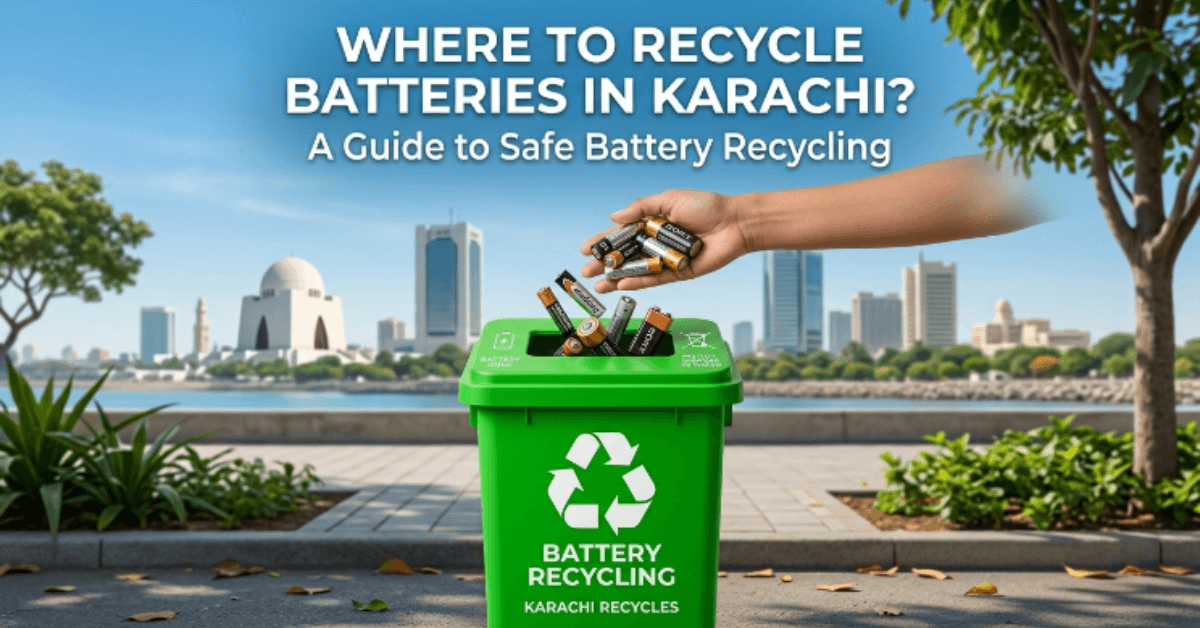
Every UPS, car, inverter, phone, and solar setup in your home runs on a battery, and every one of those batteries dies eventually. Most people in Karachi don’t know where to recycle batteries once they stop working, so many of them end up in a kitchen drawer, a rooftop storeroom, or, worse, the regular trash. That’s a real problem. A dead battery isn’t ordinary waste; it holds lead, acid, lithium, and other materials that can catch fire, burn skin, and poison soil and groundwater when they’re handled the wrong way.
This guide covers where to recycle batteries in Karachi, how the battery recycling process actually works, and how to hand off old batteries, including solar and lithium ones, without putting yourself or your neighborhood at risk.
What Types of Batteries Can You Recycle in Karachi?
Not every battery in your house needs the same treatment. Here are the end-of-life batteries you’ll come across most often, and where they typically show up:
- Lead-acid batteries – from cars, UPS units, and inverters. These are the ones you replace most often, and also the easiest to recycle.
- Solar storage batteries – tubular or lithium batteries used in home solar systems.
- Lithium-ion batteries – from phones, laptops, power banks, and electric bikes.
- Alkaline batteries – AA, AAA, C, and D cells from remotes, toys, and clocks.
- Button cell batteries – from watches, calculators, and hearing aids.
So what types of batteries can be recycled? Nearly all of them. The difference lies in how each one is handled once it’s collected, so it helps to sort your batteries by type before you drop them off anywhere.
Why You Shouldn’t Throw Old Batteries in the Trash
A battery in your garbage bag doesn’t just sit there quietly. Lead-acid batteries can crack and leak acid onto whatever’s around them. Lithium-ion cells can short-circuit if they’re crushed or punctured during collection. That short can start a fire inside a garbage truck or at a dumping site; this is exactly why battery fire risk is treated so seriously by recyclers everywhere, not just in Karachi.
Once battery waste reaches a landfill, the metals inside it- lead, cadmium, mercury- work their way into the soil and, eventually, into groundwater. That’s a direct hit on environmental protection in a city where waste management is already stretched thin.
There’s also a legal side to this. Under Sindh’s Hazardous Substances Rules, framed under the Sindh Environmental Protection Act, battery waste is classified as a hazardous substance, and its handling, storage, and disposal are regulated by the Sindh Environmental Protection Agency (SEPA). Dumping batteries carelessly isn’t just bad for the environment; it can also put you on the wrong side of these rules.
Where to Recycle Batteries in Karachi
Here’s where you can recycle old batteries actually plays out on the ground in Karachi. You have a few real options, and each one suits a different kind of battery.
Battery shops and exchange counters. Most UPS, car battery, and inverter shops across the city accept your old lead-acid battery and knock its value off a new purchase. This “exchange” system has run in Karachi for years and remains the fastest route for car and UPS batteries.
Dedicated scrap dealers for solar and lithium batteries. For a solar or lithium battery specifically, a specialized solar battery scrap dealer is a safer bet than a general kabari. These dealers know how to grade a cell, spot damage, and handle a battery that could spark or swell if it’s mishandled.
If a battery is heavy, damaged, or already leaking, moving it yourself adds risk. Some recyclers run a solar scrap pickup service that collects the battery straight from your home or office, which is worth using anytime a battery isn’t in a condition you’d want to carry down a staircase.
E-waste drives. Universities and NGOs occasionally run e-waste collection events in Karachi that take in small electronics and batteries alongside other discarded gadgets. Keep an eye out for these if you have a pile of button cells or old power banks.
How to Recycle Solar Batteries in Karachi
Can solar batteries be recycled? Yes. Whether your solar setup runs on a tubular lead-acid battery or a lithium one, both types hold recoverable lead, lithium, and other metals that a recycler can pull out and reuse.
So how do you dispose of old solar batteries the right way? Start by disconnecting the battery from your inverter or charge controller before you move it. Keep the terminals covered so nothing shorts out in transit, and don’t leave the battery sitting in direct sun while it waits to be picked up.
From there, hand it to a dealer who specializes in solar batteries rather than a general scrap buyer; they’ll test its remaining capacity and grade it correctly, which affects what you get back for it.
How Are Batteries Recycled?
The battery recycling process depends on the battery type. For a lead-acid battery, the lead plates are melted down and reused in new batteries, the acid is treated or neutralized to water, and the plastic case is shredded and recycled separately.
Lithium-ion batteries go through a different route. Recyclers sort them by chemistry, then break them down using either pyrometallurgy, which separates the mixed metal alloy, or hydrometallurgy, which recovers metals like cobalt, lithium, and nickel through chemical processing. Both methods recover valuable battery components while containing the hazardous parts.
How to Prepare a Battery Before You Recycle It
A few minutes of prep keeps a drop-off safe for you and for whoever handles the battery next:
- Tape over the terminals of loose lithium batteries to stop them from short-circuiting.
- Store used batteries in a plastic or cardboard container, never a metal one.
- Keep different battery types separate instead of mixing them in one bag.
- If a battery is leaking, wear gloves, place it in a non-metal container, and wash your hands right away if you touch any residue.
- If a battery looks swollen, don’t puncture it, bend it, or press it down. Set it aside in a cool spot, away from anything flammable, and take it to a recycler as soon as you can.
Frequently Asked Questions
Where can I recycle old batteries in Karachi?
Battery and UPS shops for lead-acid exchanges, scrap dealers and kabaris for general battery scrap, and specialized solar or lithium battery scrap dealers for solar systems, power banks, and EV-type cells.
How are batteries recycled?
Lead-acid batteries are broken down so the lead can be melted and reused, and the acid treated into water. Lithium-ion batteries undergo pyrometallurgy or hydrometallurgy to recover metals such as lithium, cobalt, and nickel.
What types of batteries can be recycled?
Lead-acid, lithium-ion, alkaline, button cell, and solar storage batteries can all be recycled, though each needs a different handling method.
Where to dispose of old batteries safely?
Never in the regular trash. Use a battery shop for an exchange or a scrap dealer that handles the specific battery type.
Bottom Line
A dead battery isn’t something to leave in a drawer or throw out with the rest of your trash. Karachi already offers options for working with it, such as exchanging it at a battery shop, handing it to a scrap dealer who can grade it, or calling for a pickup if it’s damaged or too heavy to move.
Sort your batteries by type, keep the swollen and leaking ones away from the rest, and get them to someone who actually recycles them instead of letting them pile up. That one decision keeps lead, acid, and lithium out of Karachi’s soil and water, and it keeps a fire from starting somewhere it shouldn’t.