

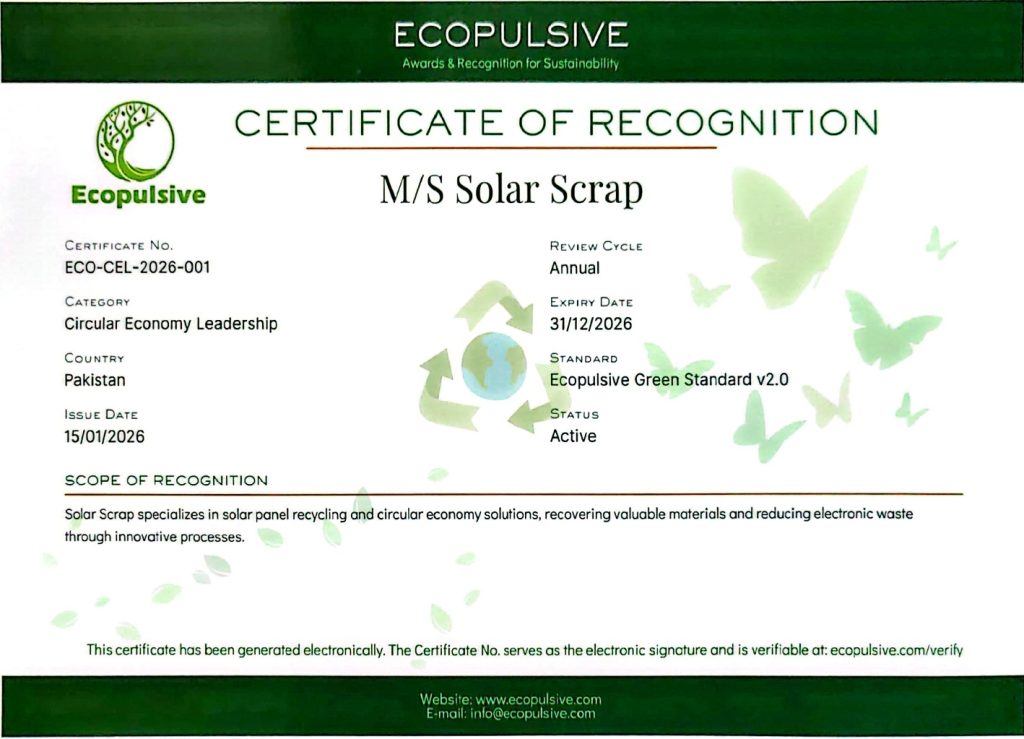
Solar Scrap, a Karachi‑based pioneer in solar panel recycling, has earned the Ecopulsive Circular Economy Leadership Certificate 2026. By recovering up to 95% of valuable materials from discarded panels, the company reduces landfill waste, creates eco‑friendly supply chains, and positions Pakistan as a hub for circular economy innovation. Led by founder Muhammad Amaduddin, Solar Scrap combines engineering expertise, ISO‑certified compliance, and community impact to prove that sustainability can be both practical and profitable.
✨ Introduction
As renewable energy grows worldwide, the fate of aging solar panels has become a pressing concern. A Karachi-based company, Solar Scrap, has turned this challenge into a business opportunity — collecting and recycling end-of-life solar equipment. Recognized with the Circular Economy Leadership Certificate 2026 by Ecopulsive (Certificate ID: ECO-CEL-2026-001 | Status: Active), Solar Scrap is setting a new standard for renewable energy waste management in Pakistan and the broader region.
⚠️ The Solar Waste Problem
Solar panels have a lifespan of roughly two to two-and-a-half decades. As solar adoption rises rapidly, a growing backlog of worn-out panels is inevitable. If left unmanaged, these discarded panels can pollute landfills, release toxic heavy metals into soil and water, and squander recoverable resources like silicon, copper, and aluminum. Pakistan’s fast-expanding solar sector makes this issue especially critical. Solar Scrap anticipated this gap early and built its entire model around keeping these materials in circulation rather than letting them go to waste.
👤 Founder: Muhammad Amaduddin
Solar Scrap’s founder and CEO, Muhammad Amaduddin, combines a strong engineering background with a genuine passion for sustainability. An NED University graduate, he has specialized in electrical power systems, occupational safety, and environmental compliance, holding certifications in ISO 14001, OHSAS 18001, and IOSH Managing Safely. These credentials directly shape Solar Scrap’s culture and operations.
His leadership steered the company to earn the Ecopulsive Circular Economy Leadership Certificate in 2026. His broader ambition includes scaling recycling operations across the country, pushing for government-level solar recycling mandates, and making Pakistan a recognized name in sustainable innovation regionally.
🎯 Mission & Vision
At its core, Solar Scrap exists to extract useful materials from decommissioned panels, keep hazardous waste out of landfills, and feed recovered resources back into manufacturing supply chains. The company’s long-term vision is to help establish Pakistan as a model for circular economy thinking — where nothing is simply thrown away, but instead finds a second life.
⚙️ How the Recycling Works
Solar Scrap follows a structured, transparent process:
- Site Assessment — Engineers evaluate installations to identify panels due for retirement.
- Transparent Bidding — A fair procurement system ensures no hidden dealings.
- Careful Dismantling — Panels are taken apart in ways that prevent contamination.
- Material Recovery — Up to 95% of a panel’s components — silicon, copper, aluminum, and glass — are successfully reclaimed.
- Reintegration — Recovered materials are supplied to manufacturers producing new eco-conscious goods.
The result is a process that is both environmentally sound and commercially viable.
📋 Standards & Compliance
Solar Scrap operates in line with ISO 14001 environmental management standards. Their Ecopulsive certification further confirms their standing as a leader in circular economy practices within the industry.
👥 Community Impact
The company’s work creates tangible benefits at the local level — reducing landfill burden in areas like Karachi’s Aligarh Society, generating jobs in recycling and logistics, and building public awareness around responsible waste disposal. These efforts connect with broader goals of community development and grassroots environmental action.
🌍 Global Context
Solar recycling is becoming a worldwide priority. The International Renewable Energy Agency projects that by 2050, expired solar panels could generate up to 78 million tonnes of waste globally — but also unlock around $15 billion worth of recoverable materials. Solar Scrap places Pakistan within this global conversation, ensuring the country is prepared rather than left behind.
🔭 What’s Next
Solar Scrap’s roadmap includes expanding its recycling infrastructure nationally, advocating for policies that make solar recycling a legal requirement, collaborating with panel manufacturers to design products with end-of-life recyclability in mind, and exploring opportunities across South Asia and the Middle East.